
Storage-Optimized Vector Search: Efficient Indexing at Scale
- Miguel Diaz
- May 15, 2026
- 04 Mins read
- AI
In the world of vector search, performance isn’t always the most important factor. When dealing with massive data volumes, storage efficiency can make the difference in costs and scalability. This is where Storage-Optimized Vector Search comes into play.
What is Storage-Optimized Vector Search?
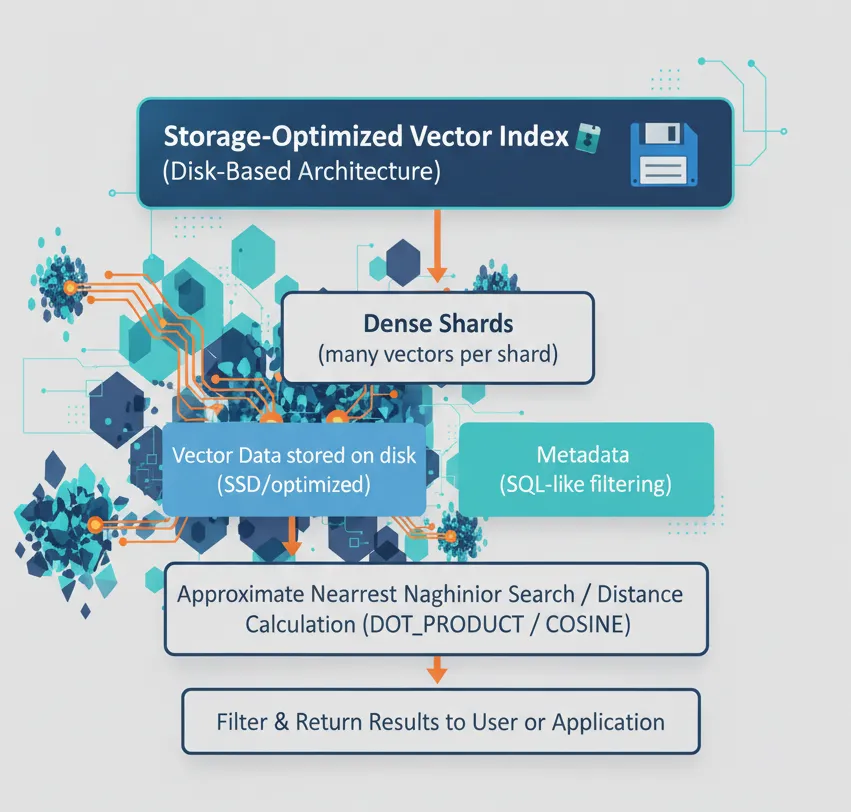
This performance tier is designed to index and search extremely large datasets using a disk-based architecture instead of relying primarily on RAM memory. Unlike performance-optimized indexes that load most data into memory to offer the lowest possible latency, this approach shifts the load to storage, allowing handling billions of vectors without infrastructure costs skyrocketing.
The impact is twofold: on one hand, significant reduction in operational costs is achieved (up to 7 times less compared to the standard option); on the other hand, it enables working with complete data lakes instead of sampling or trimming data. In exchange, searches present slightly higher latency, but in most scenarios with low query volume or tolerance for a few extra milliseconds, this trade-off is acceptable.
This means organizations of all sizes can scale their vector search, RAG, or semantic search projects, prioritizing efficiency and economic sustainability, without losing the ease of use of familiar APIs or integrated enterprise governance.
Featured Use Cases
Building AI agents that search for relevant information in massive documents, images, or videos before generating responses. Enables queries over huge datasets without sampling data, keeping costs low.
Large-scale semantic search
Improves search experience over complete data lakes, beyond keywords, understanding similarities between concepts. Ideal for companies with millions of records needing fast insights.
Entity resolution
Detects duplicates and relationships between scattered records in massive databases, including names, accounts, or products. Scalable to billions of vectors, reducing memory and processing costs.
Academics or research centers can search for patterns or relationships in massive scientific databases. Ideal when the priority is complete coverage and cost efficiency, rather than minimal latency.
Storage-Optimized Performance Trade-offs
While Storage-Optimized indexes excel in cost efficiency and scalability, they present some trade-offs that are important to consider:
| Aspect | Impact on Storage-Optimized 🔄 |
|---|---|
| Search latency | Increases slightly, as queries execute on disk instead of RAM. |
| Memory consumption (RAM) | Decreases significantly, allowing handling more data with fewer resources. |
| Operational cost | Much lower thanks to fragment reduction and efficient resource usage. |
| Ideal scenarios | Massive datasets, low QPS workloads, and applications with tolerance for small search delays. |
When to use a storage-optimized index?
A storage-optimized index is recommended in the following cases:
- Very large datasets: when indexing millions or billions of vectors in memory is not cost-viable.
- Low QPS (queries per second) workloads: if query volume isn’t that high, saving on storage is more beneficial than optimizing every millisecond.
- Flexible latency: applications that can tolerate a moderate increase in search response time.
How to configure a storage-optimized index
The key is in the shardSize parameter. To enable this tier, it should be set to:
"shardSize": "SHARD_SIZE_SO_DYNAMIC"warning
Don’t manually define the algorithm_config field. Vector Search
automatically selects the most appropriate algorithm and adjusts it based on
search patterns and your data.
Practical example
A simple configuration example would be:
{
  "displayName": "my-storage-optimized-index",
  "description": "An index configured to prioritize storage over performance.",
  "metadata": {
    "contentsDeltaUri": "gs://your-bucket/source-data/",
    "config": {
      "dimensions": 100,
      "approximateNeighborsCount": 150,
      "distanceMeasureType": "DOT_PRODUCT_DISTANCE",
      "shardSize": "SHARD_SIZE_SO_DYNAMIC"
    }
  },
  "indexUpdateMethod": "STREAM_UPDATE"
}
In this case:
- shardSize indicates that denser fragments will be created, allowing each one to contain more data.
- Other parameters (dimensions, distanceMeasureType, etc.) adapt to your application’s characteristics.
Conclusion
Storage-Optimized Vector Search doesn’t seek maximum speed, but maximum efficiency. It’s the right choice for projects where data volume is enormous, query traffic is moderate, and infrastructure costs are a priority.
This approach democratizes access to advanced vector search technologies, allowing organizations with tight budgets to implement AI and ML solutions at scale. By prioritizing economic sustainability over ultra-low latency, it opens the door to use cases that were previously unviable due to cost.
The result? RAG projects, semantic search, and intelligent recommendations that can scale to billions of vectors without compromising the project’s financial viability.
In an ecosystem where storage is increasingly economical and applications require processing massive data volumes, Storage-Optimized Vector Search positions itself as an intelligent strategy for the future of enterprise vector search.