Genie Ontology: The Context Graph That Makes Your AI Agents Truly Enterprise-Ready
- Miguel Diaz
- Jun 16, 2026
- 12 Mins read
- Databricks
Large language models are impressive. They talk about everything, in every language, with remarkable fluency. But when your analyst asks an AI agent “what were our LATAM sales in Q1, adjusted for the corporate discount from the loyalty program?”, the agent needs something no generic model ships with out of the box: context about your company.
What exactly are “LATAM sales” in your organization? Which territories does it include? Does the corporate discount apply before or after taxes? Is the authoritative source the CRM or the ERP? Without that context map, the agent gives you a fluent answer… but a hollow one.
That’s precisely what Genie Ontology is built to solve.
What is Genie Ontology?
Context Graph
A structured map of your company’s knowledge, relationships, and business logic
Self-Improving
Learns from every interaction and updates its memory without manual intervention
Governed
Every response enforced by ACLs and Unity Catalog. Zero information leakage.
Connected
50+ connectors via Lakeflow Connect: SaaS apps, databases, documents, dashboards
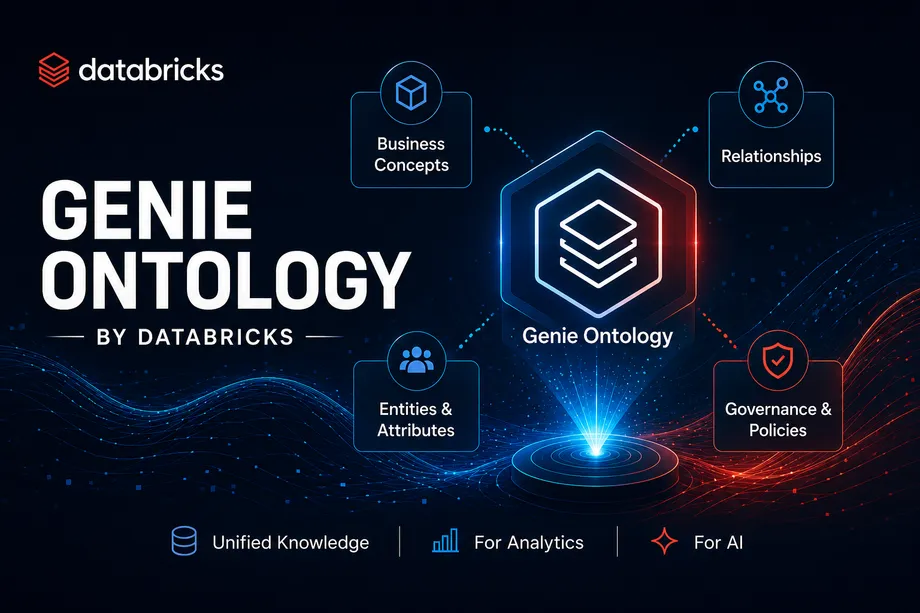
Genie Ontology is Databricks’ enterprise context graph. In plain terms: it’s the memory and contextual intelligence layer that transforms a generic AI agent into an assistant that genuinely understands your business.
It’s not a search engine. It’s not a document index. It’s a living system that extracts knowledge from everything your organization already produces —dashboards, notebooks, pipelines, SaaS systems— structures it, ranks it by authority, and makes it available to every agent with the correct permissions applied.
It entered Public Preview on June 4, 2026 and was one of the headline announcements at the Data + AI Summit (DAIS) 2026.
The Problem: 50% of Enterprise Agents Operate in Silos
The fragmented world your enterprise faces today
Dashboards
KPIs, metrics, business definitions
Documents
Policies, processes, internal manuals
SaaS Apps
Salesforce, SAP, HubSpot, Jira…
Operational Systems
ERPs, transactional databases
An agent that only sees a slice of this world produces answers that are fluent but shallow. It doesn’t know which system is the source of truth, has no access to authoritative business definitions, and can’t enforce your organization’s access permissions.
Enterprise knowledge doesn’t live in one place. It’s distributed across dozens of systems, each with its own logic, vocabulary, and format. Databricks found that 50% of enterprise agents operate in data silos, without access to the complete organizational context.
The result is predictable: generic AI assistants produce answers that sound right but don’t reflect your company’s operational reality. They can’t distinguish between “gross revenue” and “net revenue adjusted per Q4 policy.” They don’t know that “LATAM” in your company includes Brazil but excludes Mexico for certain reports. They have no idea that the authoritative customer data source is the CRM, not the ERP.
Genie Ontology exists to close exactly that gap.
How It Works: The Continuous Learning Cycle
The Genie Ontology Lifecycle
Ingestion from 50+ knowledge sources
Lakeflow Connect integrates with dashboards, notebooks, pipelines, SaaS applications (Salesforce, SAP, Google Drive, SharePoint) and operational systems. All existing organizational knowledge flows into the graph.
Knowledge Snippet Extraction
Genie One analyzes every interaction and extracts structured units of knowledge (knowledge snippets): term definitions, table relationships, SQL logic, synonyms, and business semantics. Each snippet is associated with its source and authority level.
Authority-Based Ranking
Not all knowledge carries equal weight. Genie Ontology ranks snippets by source authority: UC Semantics (formal business definitions) carries higher weight than an exploratory notebook. This ensures responses reflect the official source of truth.
Governance via Unity Catalog
Every query is filtered through Unity Catalog ACLs. If a user doesn’t have permission to access HR data, Genie Ontology excludes that context from its response. Governance is automatic, requiring no additional configuration at the agent level.
Cumulative Memory Across Interactions
The most powerful aspect: Genie One doesn’t start from scratch in every conversation. Learned snippets persist and apply to future interactions. The more it’s used, the more accurate it becomes. It’s a system that improves with actual company usage.
Knowledge Snippets: Your Company’s Structured Memory
The Knowledge Snippet concept is fundamental to understanding Genie Ontology. A snippet isn’t simply a chunk of text — it’s a structured unit of knowledge that includes:
Three Use Cases That Transform Operations
One Governed Source of Truth
Business users get trustworthy answers to complex questions that span multiple systems, with the guarantee that the source is the one your organization has officially designated.
”What was the average NPS for Enterprise customers in Q1, segmented by sales region?”
Faster, More Accurate Answers
Since Genie doesn’t “rediscover” context on every interaction — it already has it in memory — responses are faster and computational cost is significantly reduced.
Reduced latency by not having to re-learn context with each new query.
Context Reusable Across All Agents
Through open APIs and the MCP protocol, any agent or tool can consume Genie Ontology’s context. You don’t build the business map once per agent — you build it once and every tool inherits it.
Agent Bricks, Claude, GPT-4 or any AI tool can access the same context via Genie MCP.
Genie MCP: Enterprise Context in Any AI Tool
One of Genie Ontology’s smartest design decisions is that it’s not locked inside Databricks. Through the MCP (Model Context Protocol), any AI tool — Claude, Copilot, custom internal assistants, custom agents — can connect to Genie Ontology and access the same governed enterprise context.
What is MCP and Why Does It Matter?
Model Context Protocol (MCP) is an open standard that allows AI tools to access external data, tools, and workflows in a standardized way. Genie MCP exposes Genie One’s “brain” — its enterprise context graph — as an MCP server, so any compatible client can query it.
This is strategically significant: it means that even if your team prefers to use Claude or another AI model as its interface, it can bring Genie Ontology’s governed context along with it. You don’t have to choose between your preferred language model and the right enterprise context.
The Relationship with Unity Catalog Semantics
Genie Ontology doesn’t work in isolation. There’s a layered architecture where UC Semantics and Genie Ontology are complementary:
Unity Catalog Semantics
Deep, authoritative, governed knowledge. Formal definitions for critical business terms. Reviewed and validated by human experts.
Genie Ontology
Broad, auto-inferred, contextual knowledge. Learns from real interactions, pipelines, dashboards, and 50+ sources. Continuously updated. Uses UC Semantics as its authoritative anchor.
UC Semantics provides the precision foundation; Genie Ontology provides the breadth and continuous learning.
Together, they form the most complete context layer available today for enterprise AI on Databricks.
Frequently Asked Questions
Where to Start
Practical steps to adopt Genie Ontology
Enable Genie One in your Databricks workspace
Make sure Unity Catalog is enabled — it’s a governance prerequisite.
Define your priority knowledge sources
Identify the dashboards, notebooks, and SaaS systems that contain the most critical context for your organization.
Enrich UC Semantics with authoritative definitions
Your most important business metrics and terms should be defined in UC Semantics so Genie Ontology uses them as a high-authority anchor.
Measure and improve with the feedback loop
Use the snippet curation tools to correct incorrect responses. Each correction becomes a training signal that improves future responses.
Genie Ontology represents a paradigm shift in how enterprise AI accesses organizational knowledge. Instead of building agents that rediscover context on every interaction, it enables building a system that continuously accumulates, ranks, and governs that context.
For data teams already working with Databricks, this is the natural next step toward agents that are not only intellectually capable, but that genuinely understand how your company operates.