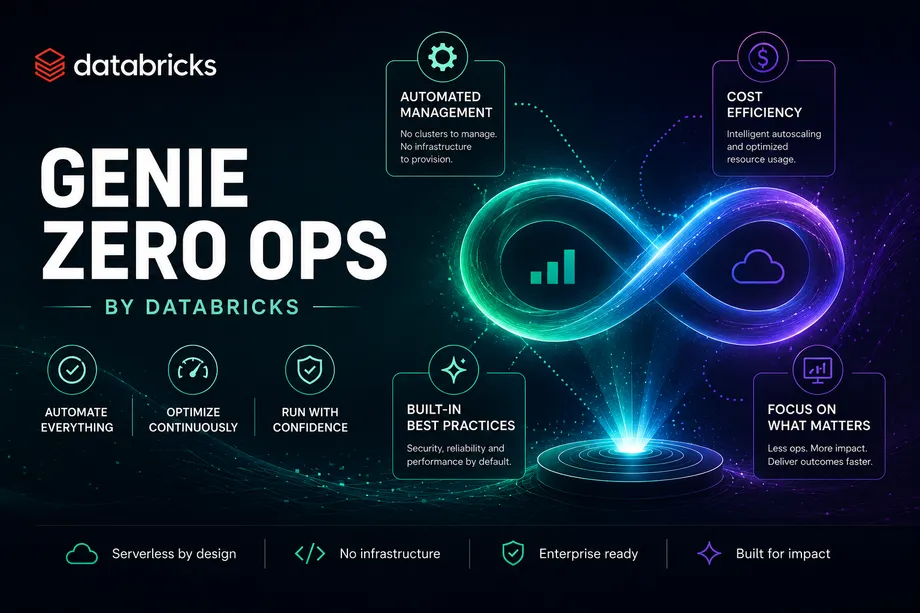
Genie ZeroOps: Automatic Diagnosis and Safe Remediation for Your Data Pipelines
- Miguel Diaz
- Jun 16, 2026
- 12 Mins read
- Databricks
It’s 2 AM. A critical ingestion job fails in production. Alerts flood the Slack channel. The on-call engineer opens the log dashboard, stares at hundreds of error lines, tries to correlate with recent schema changes, traces the data lineage, and finally — three hours later — identifies that an upstream table changed its column type the previous night.
This scenario repeats itself across thousands of data teams every week. And the problem isn’t a lack of monitoring tools: it’s that those tools alert but don’t reason. They tell you something broke. They don’t tell you why or how to fix it.
That’s exactly what Genie ZeroOps is here to change.
What is Genie ZeroOps?
Continuous monitoring
Background agent that watches jobs, pipelines, tables, and models you configure
Automatic root cause
Correlates logs, lineage, and workload context to produce the root cause — not just an alert
Isolated sandbox
The agent tests every fix in an isolated environment before proposing it. Zero production side effects
Full human control
No change reaches production without your approval. You set the guardrails per asset
Genie ZeroOps is Databricks’ native operations agent designed to automate the most expensive work any data team does: continuous monitoring, failure diagnosis, and fix proposals. Unlike traditional alerting tools, ZeroOps doesn’t just detect problems — it understands them and proposes how to resolve them, with all the safety a production environment demands.
It is currently in Private Preview (announced at DAIS 2026) and represents the first capability of its kind built directly inside the Databricks platform, with native access to data lineage, workload telemetry, and an integrated secure sandbox.
The problem behind the product
The operational reality of data teams today
Platforms grow faster than teams. More pipelines, more jobs, more models — but the same number of engineers to maintain them. Every new production asset is another potential source of 2 AM failures.
The rise of agentic tooling multiplies dependencies. AI agent pipelines create new layers of complexity. A failure in one table can propagate errors to ten downstream agents without anyone detecting it immediately.
Monitoring tools alert, but don’t reason. PagerDuty, Grafana, DataDog — all excellent at telling you something broke. None tell you why it broke or how to fix it. That gap consumes the most valuable time of your senior engineers.
The result: data practitioners spend the majority of their time monitoring and managing assets rather than building new things. Complexity and dependencies create wide blast zones and longer time-to-repair.
The real cost isn’t just downtime — it’s the senior engineering time consumed by log forensics instead of creating value. Genie ZeroOps automates exactly that diagnosis and remediation work.
How it works: two steps on autopilot
The Watch → Fix cycle of Genie ZeroOps
Monitor and diagnose (the watch step)
A background agent continuously observes the jobs, pipelines, tables, and models you’ve configured. When an error occurs, the agent doesn’t just log the failure: it correlates logs, data lineage, and workload context to produce a full root cause analysis.
Correlated logs
Events from all involved systems
Data lineage
Which upstream table changed and when
Root cause
Not just “what” failed but “why”
Suggest and apply (the fix step)
The agent drafts a fix, tests it in an isolated sandboxed environment with no production side effects, and surfaces results for your review. Nothing reaches production without your explicit approval. You set the guardrails per asset.
Proposed fix
The agent drafts the correction
Sandbox test
Isolated, without touching production
Human approval
You approve before applying
The key to the design is that these two steps execute autonomously but with the human always as the final arbiter. This isn’t blind automation — it’s informed automation with explicit control.
Three use cases that transform operations
Monitoring at scale
Let agents keep an eye on your growing production pipelines, jobs, models and apps. No matter how many assets your platform has, ZeroOps watches them all, 24/7, without alert fatigue.
”We have 400 pipelines in production. Before, an engineer watched dashboards. Now ZeroOps only alerts us when something needs a human decision.”
Automatic root cause analysis
Enterprise intelligence provides full understanding of production workloads that automates issue investigations. Correlates logs, lineage, and telemetry to reach the “why” in seconds — not hours.
From 3 hours of manual log forensics to automatic diagnosis with full context.
Safe and controlled mitigation
You set the guardrails. Agents suggest fixes, test them in sandboxed environments, and only apply a fix with explicit human approval. No production asset is touched without your consent.
Full operator control with complete automation of diagnosis and proposal.
Guardrails: safety is non-negotiable
Three integrated layers of protection
Scoped down permissions
ZeroOps operates with strictly limited permissions. The agent can only access what it needs to diagnose and propose fixes — no broad access to resources irrelevant to the asset under analysis.
Fully isolated sandbox environments
Every proposed fix is tested in an isolated sandbox — built inside the Databricks platform — with no possibility of production side effects. The agent validates the fix before presenting it, and you see the test results alongside the proposal.
Explicit human approval
No production change happens without a human approving it. Fixes are presented in an inbox-like UI prioritized by severity, with the diagnosed root cause, proposed fix, and sandbox results. The decision is always yours.
This three-layer design is what differentiates Genie ZeroOps from typical automation: it doesn’t apply fixes blindly. Every action is preceded by diagnosis, sandbox validation, and human consent.
What can Genie ZeroOps maintain?
Available now
Databricks Jobs
Pipelines (DLT, Lakeflow)
Tables (Unity Catalog)
On the roadmap
AI Models and MLflow
Databricks Apps
Lakebase databases
The initial scope covers the most critical production assets. The roadmap expands to the entire Databricks platform.
Competitive advantage: what others can’t do
Why only Databricks can build this?
Native data lineage
Unity Catalog tracks the lineage of every table, column, and transformation. When a pipeline fails, ZeroOps can trace exactly which upstream asset caused the problem — without external connectors or manual configuration.
Integrated workload telemetry
Databricks knows the state of every job, cluster, query, and model in real time. ZeroOps leverages that native telemetry to correlate failures with execution context — something impossible to replicate from external tools.
Safe sandbox built into the platform
The sandbox where ZeroOps tests fixes is part of the Databricks infrastructure, with the same security and governance controls as production. It’s not an improvised external environment — it’s a first-class platform capability.
What do other tools do?
Alert without reasoning — they tell you something broke, not why or how to fix it
Require runbooks manually written by engineers for each type of failure
Apply fixes without prior sandbox testing or validation before touching production
Third-party LLMs lack native lineage context and telemetry to reason correctly
Complements, not competitors: PagerDuty and Slack are notification surfaces, not diagnostic agents. ZeroOps complements them: Slack integration is on the roadmap so suggestions appear directly in your operational channels.
When ZeroOps is NOT the right solution
Cases where ZeroOps doesn’t apply:
- Workloads outside Databricks — native diagnosis requires access to the lineage and telemetry integrated in the platform
- Fully air-gapped environments without sandbox access — the validation step requires being able to execute the fix in an isolated environment before proposing it
Frequently asked questions
Genie ZeroOps represents a qualitative leap in how data teams manage production operations. It’s not about replacing engineers — it’s about eliminating lower-value work (log forensics, manual diagnosis, reactive management) so they can focus on building. The sandbox guarantee, human approval, and configurable guardrails make it possible to trust the automation without losing control.
It’s a product in Private Preview, but the direction is clear: the future of DataOps isn’t more monitoring dashboards — it’s reasoned automation with human control at the moments that matter.
References
- What’s coming — Databricks Release Notes
- June 2026 Release Notes — Databricks on AWS
- AI/BI and Genie Release Notes 2026
- What is Unity Catalog — Lineage and Governance
- Databricks Lakeflow — Pipeline Orchestration
- Genie Code — Agentic Engineering on Databricks
- The Next Generation of Databricks Genie (blog oficial)