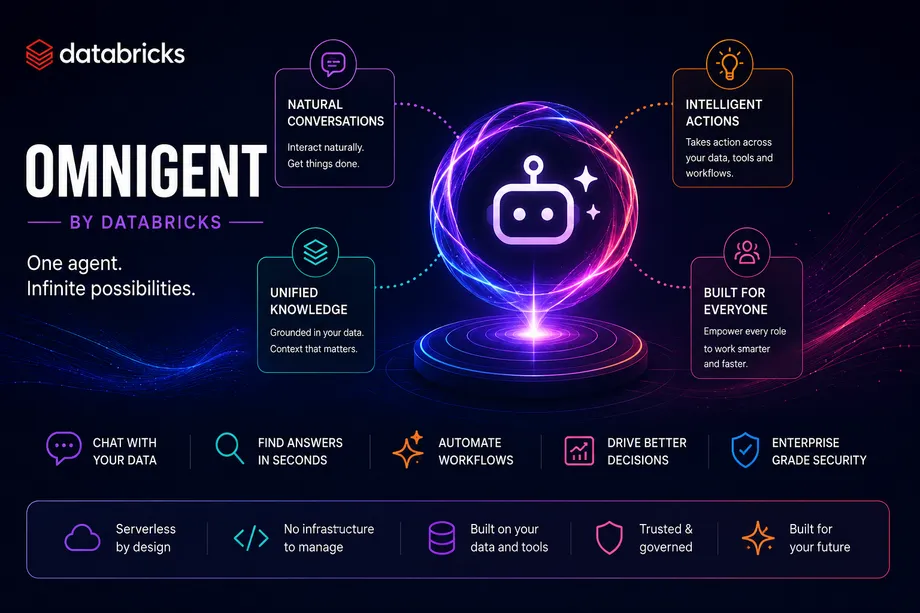
Omnigent: The Databricks Meta-Harness That Governs, Shares, and Scales Your AI Agents
- Miguel Diaz
- Jun 17, 2026
- 07 Mins read
- Databricks
The problem nobody wanted to see
84% of developers already use coding agents. By 2028, the average Fortune 500 will run more than 150,000 agents. But today, only 1 in 9 agents reaches production.
Why?
Unenforced prompt rules cause distrust, blocking ~50% of developers from running agents due to perceived risk.
Vendors ship proprietary tooling. 67% of teams using 2+ agent tools end up re-platforming their entire workflow.
Agent work is siloed on individual laptops — it can’t be shared, reused, or audited across the organization.
Omnigent solves all three simultaneously: a layer on top of existing harnesses that enforces runtime policies, centralizes the skills registry, and turns every session into a shareable asset.
What exactly is a meta-harness?
Omnigent is not another agent — it is the layer above the agents. It doesn’t compete with Claude Code, Codex, or Cursor: it governs and connects them. The only comparable option today is DIY: teams manually wiring their own policy server, audit log, and registry across tools — with nothing enterprise-ready or production-grade.
Policies · Shared Registry · Sessions · Multi-agent
How Omnigent works
Every agent action is validated against rules before it executes. Safe actions proceed; risky ones are blocked or require human approval. All actions are logged via Unity AI Gateway and Unity Catalog.
Skills, history, and model access live in a single source. Configurations travel across tools — your existing CLAUDE.md, MCPs, and skills work without any changes from day one.
Each agent session is captured server-side and can be referenced by a shared URL. Work is no longer trapped on a single developer’s laptop.
Launch many agents in parallel, server-side. Switch between harnesses and models to optimize for quality and cost without forcing the whole team to re-platform when something better appears.
Who is Omnigent for?
Agents run unattended with rules enforced at runtime. Every action is audited. No more relying on developers to follow prompt instructions — the harness enforces it.
One standard across every agent tool and model. Adopt the best one as it appears without forcing the whole team to re-platform and relearn from scratch.
Agent work becomes a shared, reusable asset — instead of being locked on one person’s laptop and lost the moment they switch tools or leave the team.
OSS vs. Managed Omnigent on Databricks
- Available on GitHub today (GA)
- Apache 2.0 license
- Drop-in wrapper — no rewrites required
- CLAUDE.md, MCP, and skills compatible
- Supports LangGraph, CrewAI, Agno and more
- Managed beta — announced at DAIS 2026
- Centralized governance with Unity AI Gateway
- Policies and MCPs next to your data in Unity Catalog
- Part of Agent Bricks for production deployments
- Integrated Supervisor API runtime
Frequently asked questions
References
- Databricks Blog: Agent Bricks — Data + AI Summit 2026
- GitHub: omnigent-ai/omnigent — official OSS repository
- Databricks Blog: AI Governance at DAIS 2026 — Unity AI Gateway
- Databricks Blog: Governing Coding Agent Sprawl with Unity AI Gateway
- MarkTechPost: Databricks Open-Sources Omnigent
- AlphaSignal: Databricks Open-Sources Omnigent to Unify and Govern Multiple AI Agents