Unity AI Gateway: Runtime Governance for All Your Enterprise AI
- Miguel Diaz
- Jun 17, 2026
- 06 Mins read
- Databricks
The problem driving uncontrolled spend
AI adoption is accelerating faster than governance can keep up. With that acceleration come three frictions organizations didn’t expect:
AI agents are now the fastest-growing source of enterprise data spend — and most organizations have no visibility into how much they spend per model, team, or application.
Organizations struggle to control what agents do, what data they expose, and how they behave in production against real users.
Traditional governance approaches were not built for multi-agent environments or ecosystems based on MCP servers and third-party frameworks.
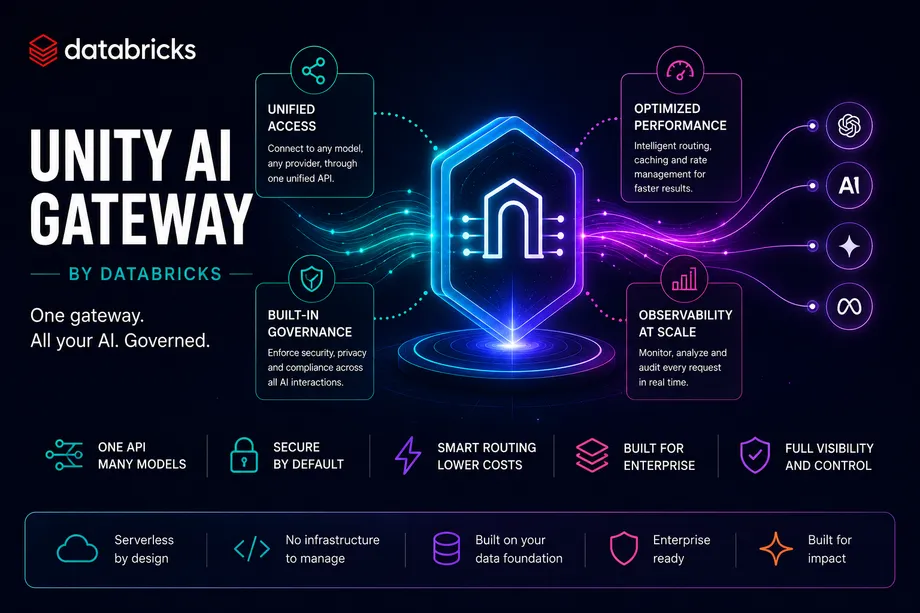
Unity AI Gateway was built to solve exactly this: a runtime governance layer that sits between your apps and all your AI providers, enforcing policies centrally regardless of the model or agent being called.
What is Unity AI Gateway?
Unity AI Gateway is a runtime governance layer for enterprise AI. It helps organizations govern AI spend, AI behavior, and AI adoption across models, agents, MCP servers, AI tools, and AI skills — all from a single control point that works wherever your AI runs.
Apps & Agents
Authentication · Policies · PII Redaction · Rate Limits · Cost Caps · Logs
How it works, step by step
All calls go through one entry point regardless of the target model or provider.
Unity Catalog identifies who is making the call (user, service, agent) and verifies their permissions before proceeding.
Applies PII redaction, content filters, per-principal rate limits, and hard cost caps before routing the request.
The request is routed to the configured model (FMAPI, OpenAI, Anthropic, Bedrock, Azure OpenAI) with automatic failover if the primary endpoint is unavailable.
Complete record for audit, per-team or per-app chargeback, and analysis with tools like Lakewatch.
Three core capabilities
AI spend governance with hard budgets, rate limits, spend attribution, and cost visibility across providers, teams, and applications.
Service policies, guardrails, approvals, and observability across models, agents, and MCP servers — applied before the call ever reaches the model.
Govern OpenAI, Anthropic, Gemini, open-source models, agents, MCP servers, and AI frameworks across providers from one single pane of glass.
Unity AI Gateway vs. Unity Catalog: what’s the difference?
Governs AI assets: registered models, datasets, features, lineage, and data access permissions.
Defines the policies and stores the context that Unity AI Gateway enforces at runtime.
Governs AI interactions at runtime: every call to a model, agent, or MCP server made by an app or agent.
Enforces in real time the policies defined in Unity Catalog before the call reaches the model.
Supported providers
Unity AI Gateway supports all major model providers natively, with automatic failover between them:
You can also govern open-source models, custom agents, third-party MCP servers, and any AI framework (LangGraph, CrewAI, Agno) through the same endpoint.