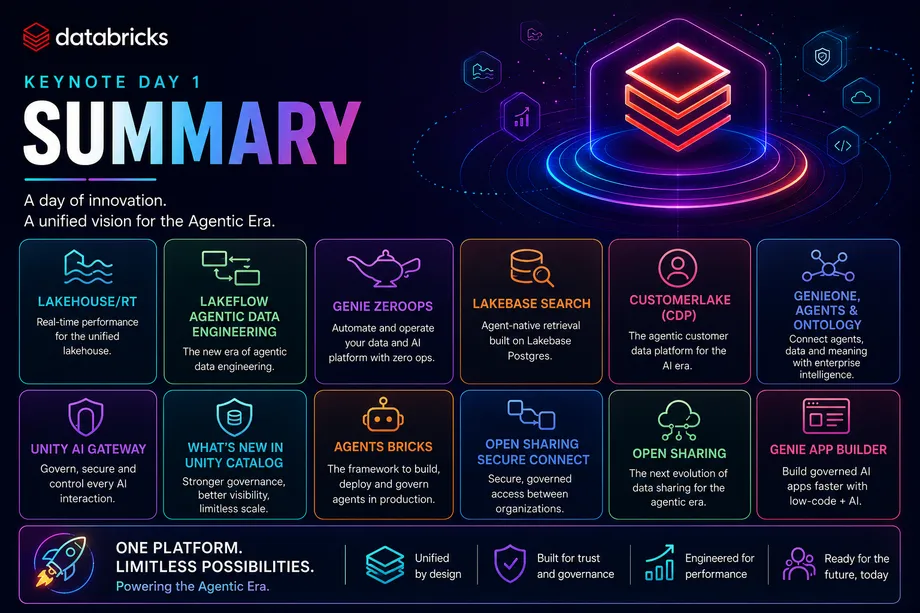
Data + AI Summit 2026: Day 1: The 12 Announcements That Redefine the Databricks Platform
- Miguel Diaz
- Jun 18, 2026
- 14 Mins read
- Databricks
The Data + AI Summit 2026 kicked off with a Keynote that will take time to fully digest. In front of more than 31,000 attendees at Moscone Center in San Francisco, Ali Ghodsi and Databricks’ top product leaders unveiled twelve announcements in under two hours, a pace we rarely see in a single opening session.
The energy in the room felt different from previous years. There was no single “star product” dominating the narrative. There were twelve. Each one targeting a real problem that data and AI teams face today. This isn’t an incremental update. It’s a redefinition of what a unified platform actually means.
The number that stopped the room: Lakehouse//RT delivers sub-100ms latency at 12,000 QPS, 16× better than existing serving layer solutions, with zero data movement. That was the moment the audience realized something had fundamentally changed.
The 12 Day 1 Announcements: Quick View
Keynote Day 1 · Databricks Data + AI Summit 2026
Reyden real-time engine: milliseconds on the lakehouse, zero data movement
Agentic data engineering: pipelines built and operated by AI agents
Zero operational overhead for Genie: fully automated management
Agent-native semantic retrieval built on top of LakeBase Postgres
Agentic CDP: unified customer data platform powered by AI
Unified Genie with semantic layer and conversational agents
Runtime governance: centralized AI spend control and policy enforcement
New governance and lineage capabilities for the agentic era
Choice/Context/Control framework for enterprise agents in production
Private networking for data sharing without exposing it outside the perimeter
The next evolution of Delta Sharing for the agentic era
Enterprise vibe-coding with automatic governance from day one
1. Lakehouse//RT: The End of Separate Serving Layers
The modern data architecture has always involved an uncomfortable trade-off: to get millisecond latency, you had to copy your data to a separate serving layer, a proprietary copy isolated from your governance, your lineage, and your analytics stack. Two systems, two pipelines, two costs, two risks.
Lakehouse//RT eliminates that.
Powered by Reyden, a brand-new execution engine built from scratch for high-concurrency, low-latency workloads, Lakehouse//RT delivers millisecond performance directly on your lakehouse data, no data movement, no copying, no second layer.
16×
better than serving layers
<100ms
at 12,000 QPS
0
duplicate data copies
The compute model is new too: AUTO sizing (no t-shirt sizes) and incremental autoscaling node by node, not doubling whole instances. Preview customers including Meta, SES, Cisco, Bally’s, Enverus, and PointClickCare saw improvements ranging from 4× to 100× on real production workloads.
Unity Catalog governance applies automatically, no need to redefine policies in a second system because there is no second system.
Official Blog: Introducing Lakehouse//RT
2. Lakeflow Agentic: The Pipeline Builds Itself
Lakeflow was already Databricks’ data engineering stack, declarative pipelines, orchestration, ingestion. With Lakeflow Agentic Data Engineering, the platform takes the leap toward pipelines that build, monitor, and repair themselves using agents.
Agentic build
Engineers describe the pipeline in natural language; agents generate the code, transformations, and orchestration schema.
Agentic operations
Agents monitor runs, detect data quality anomalies, and propose corrections, reducing on-call time for the engineering team.
The result is data engineering that scales team productivity without growing headcount proportionally, engineers stop doing plumbing and start focusing on business logic.
Official Blog: Lakeflow — A New Era of Agentic Data Engineering
3. Genie ZeroOps: Genie Without the Operational Burden
Genie is Databricks’ natural language interface for analytics, any user asks questions in plain text and gets answers about their data. The problem until today: configuring and maintaining a Genie Space required continuous work from the data team.
Genie ZeroOps eliminates that operational friction. The system automatically manages semantic context, updates business definitions as data evolves, and scales availability without anyone needing to intervene manually. Data teams go from maintaining Genie to simply using it.
ZeroOps doesn’t mean “no work”, it means the system absorbs the repetitive operational work so engineers can focus on strategic work. The difference between maintaining infrastructure and building on top of it.
Official Blog: Introducing Genie ZeroOps
4. LakeBase Search: Agent-Native Semantic Retrieval
LakeBase is Databricks’ managed Postgres, a transactional and operational database unified with the lakehouse. LakeBase Search adds semantic and vector search capabilities directly on top of LakeBase, designed specifically for AI agents to retrieve relevant information without additional infrastructure.
For RAG agents
Agents can search documents, records, and business context through native semantic search, no external vector systems required.
Unified governance
Unity Catalog access policies apply to vector indexes too, agents only retrieve what they have permission to see.
Official Blog: Announcing LakeBase Search
5. CustomerLake: The Agentic CDP Built on the Lakehouse
Traditional CDPs have the same problem as serving layers: they copy data, isolate context, and create technical debt. CustomerLake is Databricks’ answer: an agentic customer data platform built directly on the lakehouse, unifying user profiles, behaviors, and real-time signals without data movement.
Unified profile
360° customer view combining transactional, behavioral, and external data into a single governed profile.
Agentic activation
Agents that act on real-time customer signals, personalization, retention, and next-best-action at scale.
No silos
Built on Delta Lake and Unity Catalog, same governance, same lineage, same stack as the rest of the platform.
Official Blog: Introducing CustomerLake
6. GenieOne + Genie Agents + Ontology: The Unified Semantic Brain
Databricks unveiled three interconnected capabilities that transform Genie into far more than a data chatbot:
Genie Ontology
The business semantic layer: defines metrics, dimensions, relationships, and company vocabulary in a centralized model. Agents and NL queries consult the Ontology to understand data the way the business does, not just how it’s modeled in tables.
Genie Agents
Specialized conversational agents that go beyond simple Q&A, they can run multi-step analyses, compare periods, break down by dimensions, and combine multiple sources into a coherent answer.
GenieOne
The unified interface that combines dashboards, NL queries, and agents in a single coherent experience, no more switching between tools depending on what type of question you need to answer.
Official Blog: Introducing GenieOne, Genie Ontology & Genie Agents
7. Unity AI Gateway: Runtime Governance for All Your AI
Runaway generative AI spend is one of the biggest operational problems of 2026. Teams deploy dozens of models, agents, and MCP servers with no central visibility or control. Unity AI Gateway is the answer: a centralized control plane that governs all AI activity at runtime.
Spend control
Limits and alerts per model, team, or agent. No more AI bill surprises at the end of the month.
Behavior policies
Rules for which models which teams can use, with which data, under what conditions, enforced in real time.
Agent observability
Full traceability of model calls, token consumption, and agent decisions for audit and debugging.
MCP coverage
Governance extended to Model Context Protocol servers, the newest integration points in the agentic ecosystem.
Official Blog: What’s New in Unity AI Gateway — DAIS 2026
8. Unity Catalog: Governance for the Agentic Era
Unity Catalog receives a set of updates focused on supporting the agentic world: cataloging of agent tools, extended lineage for AI decision traces, access policies for MCP servers, and improvements in managing non-human identities (service principals and autonomous agents).
The central premise: if agents are going to be first-class citizens of the enterprise, they need the same governance as humans. Unity Catalog 2026 treats agents as actors with identity, permissions, and lineage, not as black boxes.
Official Blog: What’s New in Unity Catalog — DAIS 2026
9. Agent Bricks: The Infrastructure Enterprises Needed to Ship AI Agents
The headline announcement from Kasey Uhlenhuth on the DAIS 2026 stage: Agent Bricks is Databricks’ framework that organizes everything you need to move AI agents from pilot to production around three pillars.
Choice
Selecting the right model, access to all market LLMs with intelligent routing
Context
Data, tools, and document intelligence the agent needs to act correctly
Control
Governance, observability, and guardrails so the agent acts within business boundaries
Read our full Agent Bricks deep-dive →
Official Blog: Agent Bricks — DAIS 2026
10 & 11. Open Sharing + SecureConnect: Delta Sharing for the Agentic Era
Delta Sharing was Databricks’ bet on open data exchange between organizations. Open Sharing is the next evolution: a protocol for sharing not just data, but also tools, models, and agent context across organizations, the connective tissue of the cross-enterprise agentic ecosystem.
SecureConnect closes the security piece: it allows the exchange to happen over private networks, without data crossing the corporate perimeter, eliminating the risk of accidental exposure while maintaining the agility of collaboration.
Open Sharing
Share data, tools, and context between organizations through an open protocol compatible with the era of autonomous agents.
SecureConnect
Private connectivity for Open Sharing: data never leaves the controlled network perimeter, even when shared with external partners.
Official Blog: Open Sharing — Next Evolution of Delta Sharing
Official Blog: Introducing Open Sharing SecureConnect
12. Genie App Builder: Enterprise Vibe-Coding with Governance from Day One
The final announcement of the Keynote and one of the most disruptive for business teams: Genie App Builder is Databricks’ first native enterprise vibe-coding tool. Any business user describes the app they need in natural language (an intake form, a weekly dashboard, a scenario calculator) and gets it deployed, governed, and connected to their data without touching code.
The key difference vs Cursor, Lovable, or v0: Genie App Builder understands your Genie Ontology, your data sources, and your ACLs from the moment you start. No external configuration, no separate account, no schema wiring. And apps scale to zero, you don’t pay when they’re not in use.
Read our full Genie App Builder deep-dive →
Official Blog: Enabling Governed Vibe-Coding for Enterprise Apps
The Common Thread: A Truly Unified Platform
If there’s one thesis connecting all 12 Day 1 announcements, it’s this: Databricks is eliminating the concept of a “side B” in your architecture.
Every time the market answered a problem by adding a separate layer (a serving layer for latency, a CDP for customers, a vector system for search, an external tool for vibe-coding) Databricks is announcing today that problem has a native solution in the lakehouse.
It’s not just convenience. It’s an architectural stance: data shouldn’t move, governance controls shouldn’t be redefined twice, and the operational cost of maintaining fragmented stacks is a tax that organizations shouldn’t have to pay.
For Talentbricks Communities
If you’re evaluating where to focus your Databricks training in 2026, the Day 1 announcements draw a clear roadmap: Lakehouse//RT for low-latency workloads, Agent Bricks for enterprise agentic projects, and Unity AI Gateway for any organization that needs real governance over their AI. The Databricks Data Engineer certification and the DE Professional are more relevant today than they were six months ago.
All Day 1 Official References
- Introducing Lakehouse//RT: Real-Time Performance on a Unified Lakehouse
- Lakeflow: A New Era of Agentic Data Engineering
- Introducing Genie ZeroOps
- Announcing LakeBase Search: Agent-Native Retrieval Built on LakeBase Postgres
- Introducing CustomerLake: The Agentic CDP
- Introducing GenieOne, Genie Ontology & Genie Agents
- AI Governance at DAIS 2026: What’s New in Unity AI Gateway
- What’s New in Unity Catalog at Data + AI Summit 2026
- Agent Bricks: DAIS 2026
- Introducing Open Sharing SecureConnect
- Introducing Open Sharing: Next Evolution of Delta Sharing for the Agentic Era
- Enabling Governed Vibe-Coding for Enterprise Apps with Databricks