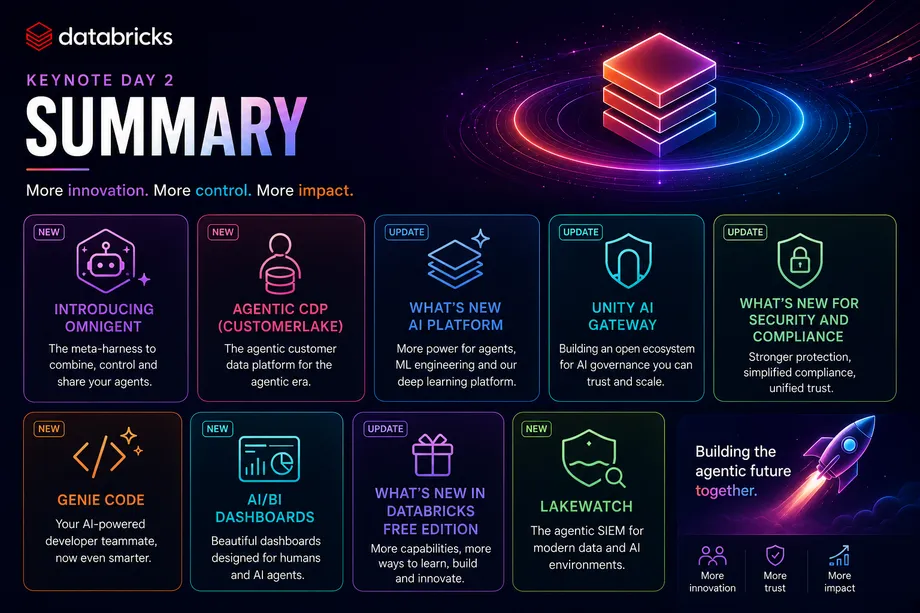
Data + AI Summit 2026: Day 2: The 9 Keynote Announcements That Complete the Agentic Platform
- Miguel Diaz
- Jun 18, 2026
- 14 Mins read
- Databricks
While Day 1 of the Data + AI Summit 2026 laid the foundations (Lakehouse//RT, Agent Bricks, CustomerLake, Open Sharing) Day 2 focused on showing how those pillars connect into a coherent, governed, and accessible stack for every role in the organization.
Nine announcements. From security to user experience, from developer tooling to the free tier of the platform.
The 9 Day 2 Announcements: Quick View
Keynote Day 2 · Databricks Data + AI Summit 2026
OSS meta-harness that governs, shares, and scales agents across any framework
Why traditional CDPs are broken and what a truly agentic CDP means
Mosaic AI, ML Engineering, Deep Learning and new agentic capabilities
Building an open ecosystem for enterprise AI governance
New platform-level security and compliance capabilities
AI code assistant for data engineers and scientists inside Databricks
Beautiful, expressive dashboards powered by generative AI
Free tier expansion with new capabilities and higher limits
The modernized SOC: native SIEM on the security lakehouse with AI
1. Omnigent: The Meta-Harness to Govern, Share and Scale Agents
The question that has gone unanswered in the agentic space for two years: how do you govern, share, and scale agents you’ve already built in Claude Code, Codex, Cursor or any other framework, without rewriting everything from scratch?
Omnigent is Databricks’ answer. It’s the open source meta-harness that sits on top of any existing agent framework and adds three cross-cutting capabilities without requiring changes to the underlying agent:
Govern
Unity Catalog governance over all agents: identities, permissions, lineage and auditing applied automatically
Share
Agent discovery and distribution across teams with a built-in catalog and version control
Scale
Agent execution at Databricks platform scale, with centralized observability and management
The number that puts the problem in context: only 11% of agents in pilot reach production today. Omnigent targets the causes of that 89% that gets stuck, not the model, but the infrastructure around it.
Works across any framework
Claude Code, Codex, Cursor, LangChain, LlamaIndex, Omnigent is a harness that wraps on top without requiring changes to the base agent.
Automatic governance from Unity Catalog
Every agent registered in Omnigent inherits Unity Catalog policies, permissions, ACLs, lineage, and auditing with no extra configuration.
Read full Omnigent blog post →
Official Blog: Introducing Omnigent
2. CustomerLake: Why CustomerLake Is Different
Day 1 introduced CustomerLake as a product. Day 2 was the moment for the deeper explanation: what does it actually mean for a CDP to be agentic? And why are traditional CDPs not enough?
Traditional CDP
- ✗ Data copied into proprietary systems
- ✗ Static, batch-based segmentation
- ✗ Manual activation with rigid pipelines
- ✗ Duplicated governance out of sync
CustomerLake (Agentic CDP)
- ✓ Data stays in the lakehouse, zero duplication
- ✓ Dynamic real-time segments
- ✓ Agents that autonomously trigger next-best-action
- ✓ Unified Unity Catalog governance
An agentic CDP doesn’t just store customer data, it uses it actively to trigger agent actions: real-time recommendations, churn prevention before it happens, individual-level personalization without nightly batches.
Official Blog: What Is an Agentic CDP?
3. AI Platform Updates: Agents, ML Engineering and Deep Learning
The Databricks AI Platform (Mosaic AI) receives a broad set of improvements in Day 2 covering the full enterprise AI lifecycle: from model training to agent deployment, including fine-tuning and evaluation.
New Mosaic AI Agent Framework capabilities: multi-agent orchestration, improved tool execution, automatic behavior evaluation.
MLflow updated with native support for agent traces, new model registry functions, and simplified deployment to Model Serving.
Improvements to distributed training, fine-tuning of proprietary LLMs, and access to optimized GPU infrastructure directly from the platform.
Official Blog: What’s New in the AI Platform — DAIS 2026
4. Unity AI Gateway: Building the Open AI Governance Ecosystem
Day 1 introduced Unity AI Gateway as a product. Day 2 expanded the vision: Unity AI Gateway isn’t just a centralized control point, it’s the core of an open AI governance ecosystem that connects Databricks with third parties, partners, and market frameworks.
Integration with external providers
OpenAI, Anthropic, AWS Bedrock, Azure OpenAI and all major model providers integrate directly, with the same governance policies applied regardless of provider.
MCP as a first-class citizen
Model Context Protocol servers are governed by the same policies as models, authentication, rate limits, PII redaction, and observability applied to all agentic integration points.
End-to-end observability
Complete traces from user request to model response, with breakdown of latencies, tokens, costs, and routing decisions visible in a centralized dashboard.
Official Blog: Building an Open Ecosystem for AI Governance with Unity AI Gateway
5. Security & Compliance: Platform Protection for the Agentic Era
Autonomous agents create attack surfaces that didn’t exist in the traditional pipeline world. Day 2 dedicated a full block to showing how Databricks has extended its security and compliance capabilities to cover the agentic world.
Non-human identities
Service principals and autonomous agents with their own identities, granular permissions, and managed lifecycle, treated as first-class actors in the security model.
New compliance certifications
Expanded SOC 2, ISO 27001, HIPAA, and financial industry certifications, with extended coverage for AI agent and model workloads.
Agent action auditing
Immutable log of every action taken by autonomous agents: what tool they invoked, what data they accessed, with what result, with configurable retention.
Network isolation for agents
Network isolation policies applicable at the individual agent level, precise control over which external systems each agent can reach.
Official Blog: What’s New in Databricks Security & Compliance — DAIS 2026
6. Genie Code: The Native AI Code Assistant for Databricks
Genie isn’t just for business analysts. Genie Code brings conversational AI capabilities to the workflow of data engineers, data scientists, and ML developers, directly inside Databricks notebooks and the IDE.
Context-aware code generation
Suggests and generates PySpark, SQL, and Python code with understanding of table schemas, existing pipelines, and the current notebook context.
AI-assisted debugging
Identifies root causes of errors in pipelines and notebooks, proposes fixes, and explains the problem in plain language.
Automatic documentation
Generates inline documentation of functions, transformations, and pipelines, keeping the codebase readable without manual effort.
Genie Code isn’t an external plugin or third-party integration, it’s a native Databricks capability that understands your full stack: Unity Catalog, Lakeflow pipelines, MLflow experiments, and the full context of your workspace.
Official Blog: What’s New in Genie Code — DAIS 2026
7. AI/BI Dashboards: Beautiful Visualizations Generated with AI
Databricks dashboards already existed. AI/BI Dashboards are something different: AI-generated visualizations that understand the meaning of data, not just its format. In Day 2, the team presented the new generation of AI/BI with AI-assisted design capabilities that produce expressive dashboards from natural language.
Prompt-driven design
Describe the dashboard you need in natural language: “show me last quarter’s sales by region with a YoY comparison” and the system generates the layout, charts, and queries.
Beautiful by default
New rendering engine that prioritizes readability and visual expressiveness, AI-generated dashboards have presentation-quality design from the very first attempt.
Automatic contextualization
The system uses the Genie Ontology to understand business metrics, it doesn’t generate raw data charts, it generates insights with business context embedded.
Interactivity with Genie
Dashboards have Genie built in, viewers can ask questions directly about the data being shown without leaving the visualization.
Official Blog: Design Beautiful Dashboards with AI/BI
8. Databricks Free Edition: What’s Coming Next
The Databricks Free Edition exists so any team can get started with the platform without cost friction. Day 2 presented the roadmap of what’s coming: more capabilities, higher limits, and access to the new agentic features without needing a paid account.
Genie access
Genie available in the Free Edition for natural language data queries, democratizing access to conversational analytics.
Basic Agent Bricks
Agent prototyping with the core Agent Bricks capabilities included in the free tier, so any developer can experiment.
Higher limits
More compute, more storage, and more runs included for experimentation projects, lowering the barrier to entry for small teams.
The Free Edition is the on-ramp for the next generation of data professionals. The most important announcements from DAIS 2026 also reaching the free tier is a clear signal of Databricks’ bet on the ecosystem, not just enterprise customers.
Official Blog: What’s Coming Next for Databricks Free Edition
9. LakeWatch: The Native Agentic SIEM from Databricks
Traditional SIEMs have three structural problems the market has been tolerating for years: data locked in proprietary formats, prohibitive ingestion costs, and limited historical retention. LakeWatch solves all three at once.
It’s Databricks’ agentic SIEM, built on the Security Lakehouse, the same infrastructure that already governs business data, now extended to security telemetry, IT logs, and threat signals.
Medallion architecture for security
Bronze: raw logs with full-text search, 365+ day retention at object storage cost. Silver: enriched and normalized data. Gold: OCSF-aligned, ready for analytics and detections.
OCSF, the open standard
All logs normalize to the Open Cybersecurity Schema Framework: a common taxonomy that eliminates manual parsing work and enables immediate cross-source correlation.
Genie for threat hunting
SOC analysts ask in natural language: “is there unusual activity from European IPs in the last 72 hours?”, without needing to write SPL or KQL queries.
Unified governance with business data
Security data flows through Unity Catalog, same permissions, same lineage, same cost control as the rest of the platform. The SOC works with the same infrastructure as data teams.
Read full LakeWatch blog post →
Official Blog: Databricks Announces LakeWatch
DAIS 2026 in Perspective: Two Days, One Platform
After two full days of keynotes, Databricks’ message is consistent from beginning to end: the fragmentation of the data and AI stack has a cost that organizations no longer have to pay.
Day 1 built the pillars of performance and product expansion. Day 2 connected them: cross-cutting governance with Unity Catalog and Unity AI Gateway, native security for agents, tools for every profile (analysts, developers, the SOC), and democratization through an expanded Free Edition.
Perspective for Talentbricks Communities
The Day 2 announcements reinforce a clear trend: security teams (LakeWatch), developers (Genie Code), analysts (AI/BI Dashboards), and data scientists (AI Platform) are all converging on the same platform. Knowing Databricks is no longer a niche skill, it’s the core skill of the 2026 data professional.
All Day 2 Official References
- Introducing Omnigent: The Meta-Harness to Combine, Control and Share Your Agents
- What Is an Agentic CDP?
- What’s New in the AI Platform: Agents, ML Engineering, Deep Learning & New Capabilities
- Building an Open Ecosystem for AI Governance with Unity AI Gateway
- What’s New in Databricks Platform Security and Compliance — DAIS 2026
- What’s New in Genie Code — Data + AI Summit 2026
- Design Beautiful Dashboards with AI/BI
- What’s Coming Next for Databricks Free Edition
- Databricks Announces LakeWatch: A New Agentic SIEM